

 |
| Mocked Eiffel Tower |


 |
| VOIP Setup |
1: public static String calTimeDifference(String startHour,
String startMin, String endHour, String endMin){
2:
3: String total = "0";
4:
5: if (!StringUtils.isEmpty(startHour) &&
!StringUtils.isEmpty(startMin) &&
!StringUtils.isEmpty(endHour) &&
!StringUtils.isEmpty(endMin){
6:
7: int stHr = Integer.parseInt(startHour) * 60 ;
8:
9: int stMn = Integer.parseInt(startMin);
10:
11: int enHr = Integer.parseInt(endHour) * 60 ;
12:
13: int enMn = Integer.parseInt(endMin);
14:
15: int startTime = stHr + stMn;
16:
17: int endTime = enHr + enMn;
18:
19: if (endTime > startTime){
20:
21: int durationHr = (endTime - startTime)/60;
22:
23: int durationMn = (endTime - startTime)%60;
24:
25: total = Integer.toString(durationHr) + " Hr and "
+ Integer.toString(durationMn) + " Min" ;
26:
27: }
28:
29: else{
30:
31: total = "Ending Time cannot be before Starting Time";
32:
33: }
34:
35: }
36:
37: return total;
38:
39: }
org.springframework.web.HttpMediaTypeNotAcceptableException: Could not find acceptable representation
1:  @Configuration
2:  public class ContentNegotiationConfig extends WebMvcConfigurerAdapter {
3:    @Override
4:    public void configureContentNegotiation(final ContentNegotiationConfigurer configurer) {
5:      // Turn off suffix-based content negotiation
6:      configurer.favorPathExtension(false);
7:    }
8:  }
1:  public class UnauthorizedEntryPoint implements AuthenticationEntryPoint {
2:
3:    @Override
4:    public void commence(HttpServletRequest request, HttpServletResponse response, AuthenticationException authException) throws IOException, ServletException {
5:
6:      //log statement if you want to log it to server logs.
7:      response.sendError(HttpServletResponse.SC_UNAUTHORIZED, "User Authentication cannot be verified, Please log in again with your credentials");
8:
9:    }
10:  }
1: http.exceptionHandling().authenticationEntryPoint(new UnauthorizedEntryPoint());
1:   public void createCurrentView()
2:   {
3:     FacesContext context = FacesContext.getCurrentInstance();
4:     Application application = context.getApplication();
5:     ViewHandler viewHandler = application.getViewHandler();
6:     UIViewRoot viewRoot =
7:            viewHandler.createView(context, context.getViewRoot().getViewId());

8:     context.setViewRoot(viewRoot);
9:     context.renderResponse();
10:   }
1:  changeSet(id: '1451109624', author: 'wakasmalik') {
2:      createTable(tableName: 'LiquibaseExample) {
3:        column(name: 'ID, type: 'NUMBER(19, 0)') {
4:          constraints(nullable: false)
5:        }
6:        column(name: 'ABC', type: 'VARCHAR2(255 CHAR)')
7:        column(name: 'DEF', type: 'VARCHAR2(255 CHAR)')
8:        column(name: 'DATE_SAVED', type: 'TIMESTAMP')
9:        column(name: 'DATE_CREATED', type: 'TIMESTAMP') {
10:          constraints(nullable: false)
11:        }
12:        column(name: 'CREATED_BY', type: 'NUMBER(19, 0)') {
13:          constraints(nullable: false)
14:        }
15:        column(name: 'MODIFIED_BY', type: 'NUMBER(19, 0)') {
16:          constraints(nullable: false)
17:        }
18:      }
19:    }
20:    changeSet(id: '14511096241', author: 'wakasmalik') {
21:      addPrimaryKey(columnNames: 'ID', constraintName: 'primaryKey', tableName: 'LiquibaseExample')
22:    }
1:  changeSet(id: '1451273089', author: 'wakasmalik') {
2:      modifyDataType(tableName: "LiquibaseExample", columnName: "ABC", newDataType: "NUMBER(19, 0)")
3:      modifyDataType(tableName: "LiquibaseExample", columnName: "CREATED_BY", newDataType: "VARCHAR2(255 CHAR)")
4:    }
1:  changeSet(id: '1451365535', author: 'wakasmalik') {
2:      dropColumn(columnName: 'ABC', tableName: 'LiquibaseExample')
3:      dropColumn(columnName: 'CREATED_BY', tableName: 'LiquibaseExample')
4:      addColumn(tableName: 'LiquibaseExample') {
5:        column(name: 'ABC', type: 'NUMBER(19, 0)')
6:        column(name: 'CREATED_BY', type: 'VARCHAR2(255 CHAR)')
7:      }
8:      sql("UPDATE LiquibaseExample SET ABC = 11111")
9:      sql("UPDATE LiquibaseExample SET CREATED_BY = '11111'")
10:     addNotNullConstraint(columnName: 'CREATED_BY', tableName: 'LiquibaseExample')
11:    }
1:  @Configuration
2:  public class SecurityConfigurerAdapter extends WebSecurityConfigurerAdapter {
3:       @Override
4:       protected void configure(HttpSecurity http) throws Exception {
5:            http
6:                      .csrf()
7:                      .disable()
8:                      .and()
9:                      .authorizeRequests()
10:                    .anyRequest()
11:                    .authenticated()
12:                    .and()
13:                    .formLogin()
14:                    .permitAll()
15:                    .and()
16:                    .logout()
17:                    .deleteCookies("remove")
18:                    .invalidateHttpSession(false)
19:                    .logoutRequestMatcher(new AntPathRequestMatcher("/logout"))
20:                    .logoutSuccessUrl("/login");
21:       }
 |
| Flappy Andy |
In the 20×20 grid below, four numbers along a diagonal line have been marked in red.
What is the greatest product of four adjacent numbers in the same direction (up, down, left, right, or diagonally) in the 20×20 grid?
1:  /**
2:   * Created by Waqas on 1/14/2015.
3:   */
4:  public class Problem_Eleven {
5:
6:    public static void main(String [] args){
7:
8:      int numbersArray [][] = readNumberArray();
9:      int largestProductOfFourAdjNumbers = 0;
10:      int actualNumbers[] = new int[4];
11:      boolean isDiagonal = false;
12:
13:      for(int i = 0; i < 20; i++){
14:        for(int j = 0; j < 17; j++){
15:          int product = getProductOfFourNumbers(numbersArray[i][j], numbersArray[i][j + 1], numbersArray[i][j + 2], numbersArray[i][j + 3]);
16:
17:          if(largestProduct(product, largestProductOfFourAdjNumbers))
18:          {
19:            largestProductOfFourAdjNumbers = product;
20:
21:            actualNumbers[0] = numbersArray[i][j];
22:            actualNumbers[1] = numbersArray[i][j + 1];
23:            actualNumbers[2] = numbersArray[i][j + 2];
24:            actualNumbers[3] = numbersArray[i][j + 3];
25:
26:            isDiagonal = false;
27:          }
28:        }
29:      }
30:
31:      for(int i = 0; i < 17; i ++){
32:        for(int j = 0; j < 20; j++){
33:          int product = getProductOfFourNumbers(numbersArray[i][j], numbersArray[i + 1][j], numbersArray[i + 2][j], numbersArray[i + 3][j]);
34:
35:          if(largestProduct(product, largestProductOfFourAdjNumbers))
36:          {
37:            largestProductOfFourAdjNumbers = product;
38:
39:            actualNumbers[0] = numbersArray[i][j];
40:            actualNumbers[1] = numbersArray[i + 1][j];
41:            actualNumbers[2] = numbersArray[i + 2][j];
42:            actualNumbers[3] = numbersArray[i + 3][j];
43:
44:            isDiagonal = false;
45:          }
46:        }
47:      }
48:
49:      for(int i = 0; i < 17; i++){
50:        for(int j = 0; j < 17; j++){
51:          int product = getProductOfFourNumbers(numbersArray[i][j],numbersArray[i + 1][j + 1],numbersArray[i + 2][j + 2], numbersArray[i + 3][i + 3]);
52:
53:          if(largestProduct(product, largestProductOfFourAdjNumbers))
54:          {
55:            largestProductOfFourAdjNumbers = product;
56:
57:            actualNumbers[0] = numbersArray[i][j];
58:            actualNumbers[1] = numbersArray[i + 1][j + 1];
59:            actualNumbers[2] = numbersArray[i + 2][j + 2];
60:            actualNumbers[3] = numbersArray[i + 3][i + 3];
61:
62:            isDiagonal = true;
63:          }
64:        }
65:      }
66:
67:      for(int i = 0; i < 17; i ++){
68:        for(int j = 3; j < 20; j ++){
69:          int product = getProductOfFourNumbers(numbersArray[i][j],numbersArray[i + 1][j - 1],numbersArray[i + 2][j - 2],numbersArray[i + 3][j - 3]);
70:
71:          if(largestProduct(product, largestProductOfFourAdjNumbers))
72:          {
73:            largestProductOfFourAdjNumbers = product;
74:
75:            actualNumbers[0] = numbersArray[i][j];
76:            actualNumbers[1] = numbersArray[i + 1][j - 1];
77:            actualNumbers[2] = numbersArray[i + 2][j - 2];
78:            actualNumbers[3] = numbersArray[i + 3][j - 3];
79:
80:            isDiagonal = true;
81:          }
82:        }
83:      }
84:
85:      System.out.format("Max Product of these %d * %d * %d * %d four Numbers = %d",actualNumbers[0],actualNumbers[1],actualNumbers[2],actualNumbers[3],largestProductOfFourAdjNumbers);
86:
87:      if (isDiagonal) {
88:        System.out.print(". And these numbers are diagonal to each other");
89:      } else {
90:        System.out.print(". And these numbers are adjacent to each other");
91:      }
92:    }
93:
94:    private static int getProductOfFourNumbers(int one, int two, int three, int four){
95:      return one * two * three * four;
96:    }
97:
98:    private static boolean largestProduct(int product, int largestNumberProduct){
99:      if(product > largestNumberProduct)
100:        return true;
101:      else
102:        return false;
103:    }
104:
105:    private static int[][] readNumberArray()
106:    {
107:      return new int [][] {
108:          {8,02,22,97,38,15,00,40,00,75,04,05,07,78,52,12,50,77,91,8},
109:          {49,49,99,40,17,81,18,57,60,87,17,40,98,43,69,48,04,56,62,00},
110:          {81,49,31,73,55,79,14,29,93,71,40,67,53,88,30,03,49,13,36,65},
111:          {52,70,95,23,04,60,11,42,69,24,68,56,01,32,56,71,37,02,36,91},
112:          {22,31,16,71,51,67,63,89,41,92,36,54,22,40,40,28,66,33,13,80},
113:          {24,47,32,60,99,03,45,02,44,75,33,53,78,36,84,20,35,17,12,50},
114:          {32,98,81,28,64,23,67,10,26,38,40,67,59,54,70,66,18,38,64,70},
115:          {67,26,20,68,02,62,12,20,95,63,94,39,63,8,40,91,66,49,94,21},
116:          {24,55,58,05,66,73,99,26,97,17,78,78,96,83,14,88,34,89,63,72},
117:          {21,36,23,9,75,00,76,44,20,45,35,14,00,61,33,97,34,31,33,95},
118:          {78,17,53,28,22,75,31,67,15,94,03,80,04,62,16,14,9,53,56,92},
119:          {16,39,05,42,96,35,31,47,55,58,88,24,00,17,54,24,36,29,85,57},
120:          {86,56,00,48,35,71,89,07,05,44,44,37,44,60,21,58,51,54,17,58},
121:          {19,80,81,68,05,94,47,69,28,73,92,13,86,52,17,77,04,89,55,40},
122:          {04,52,8,83,97,35,99,16,07,97,57,32,16,26,26,79,33,27,98,66},
123:          {88,36,68,87,57,62,20,72,03,46,33,67,46,55,12,32,63,93,53,69},
124:          {04,42,16,73,38,25,39,11,24,94,72,18,8,46,29,32,40,62,76,36},
125:          {20,69,36,41,72,30,23,88,34,62,99,69,82,67,59,85,74,04,36,16},
126:          {20,73,35,29,78,31,90,01,74,31,49,71,48,86,81,16,23,57,05,54},
127:          {01,70,54,71,83,51,54,69,16,92,33,48,61,43,52,01,89,19,67,48}
128:      };
129:
130:    }
131:  }
132:
Just a few days back I saw a weird problem in my computer, whenever I googled something and try to click any search link it always redirects me to a different page. For sure, that’s a virus but now how to remove as search result links takes me somewhere else. Even Bing or Yahoo doesn’t come to rescue. Hmm, that’s Google Redirect Virus (GRV).
Symptoms:
The main symptom of the GRV is that clicking on a Google search result link will take you to another unrelated website. It doesn’t matter which search link you click and it doesn’t matter which browser you use for searching. How can you get it? Unfortunately, it’s not very difficult. If you accidentally (or even purposely) visit a malicious or infected website, and if you don’t have the necessary anti-virus protection on your computer, you can get it.
But unlike most cases of malware, this virus embeds itself deeper into your system and requires more than a simple malware scan.
How to remove it?
Did a lot of research and believe me there were so many solutions available (some say malware byte, some say TDSSKiller) will remove but none of them work. Hmm, finally found fixTDSS.exe
Simply download fixTDSS.exe and run it. After the program initializes, click on the Proceed button to start the scan. The program will look for potential problems and fix them if necessary. A reboot may be required.
Is fixTDSS.exe Safe?
It’s written by Symantec, the makers of Norton antivirus and also the above downloadable link will download the file from Symantec’s website directly.
fixTDSS.exe has some conflicts with windows 7 so you have to reinstall or recover your operating system from the recovery disk. Restoring it to an earlier point or reinstalling windows from one of the images stored on your local hard disk is not going to work, so make sure you have the recovery disk for your operating system.
Any comments or suggestions are always welcomed.
One of the basic step before coding is creating the flowchart. A flowchart is a type of diagram, that represents an algorithm or process, showing the steps as boxes of various kinds, and their order by connecting these with arrows. A flowchart will give you a step-by-step solution to a given problem. So lets consider an ATM transaction today.
Scenario: The customer goes to a ATM machine and insert his ATM/Debit, enters his pin number, do his transaction, which can be withdrawal, deposit or just a simple balance check query, get his card back and left.
ATM’s Perspective: ATM/Debit card is inserted, the ATM validates the validity of the account associated and pin with the card, once the account is validated the ATM receives the account information, and then processes the customer’s request, if that’s valid again. At the end if there is no more requests coming from customer, returns the card.

Any comments or suggestions are most welcome.
If Windows ever notifies you about a weak signal, it probably means your connection isn't as fast or as reliable as it could be. Worse, you might lose your connection entirely in some parts of your home. If you're looking to improve the signal for your wireless network, try some of these tips for extending your wireless range and improving your wireless network performance.

If your wireless router is against an outside wall of your home, the signal will be weak on the other side of your home. Don't worry if you can't move your wireless router, because there are many other ways to improve your connection.
Metal, walls, and floors will interfere with your router's wireless signals. The closer your router is to these obstructions, the more severe the interference, and the weaker your connection will be.
The antennas supplied with your router are designed to be Omni-directional, meaning they broadcast in all directions around the router. If your router is near an outside wall, half of the wireless signals will be sent outsid
Wireless network signals must be sent both to and from your computer. Sometimes, your router can broadcast strongly enough to reach your computer, but your computer can't send signals back to your router. To improve this, replace your laptop's PC card-based wireless network adapter with a USB network adapter that uses an external antenna. In particular, consider the Hawking Hi-Gain Wireless USB network adapter, which adds an external, hi-gain antenna to your computer and can significantly improve your range. Laptops with built-in wireless typically have excellent antennas and don't need to have their network adapters upgraded.
Wireless repeaters extend your wireless
Wireless routers can broadcast on several different channels, similar to the way radio stations use different channels. In the United States and Canada, these channels are 1, 6, and 11. Just like you'll sometimes hear interference on one radio station while another is perfectly clear, sometimes one wireless channel is clearer than others. Try changing your wireless router's channel through your router's configuration page to see if your signal strength improves. You don't need to change your computer's configuration, because it'll automatically detect the new channel.
If you have cordless phones or other wireless electronics in your home, your computer might not be able to "hear" your router over the noise from the other wireless devices. To quiet the noise, avoid wireless electronics that use the 2.4GHz frequency. Instead, look for cordless phones that use the 5.8GHz or 900MHz frequencies.
Router manufacturers regularly make free improvements to their routers. Sometimes, these improvements increase performance. To get the latest firmware updates for your router, visit your router manufacturer's website. Similarly, network adapter vendors occasionally update the software that Windows uses to communicate with your network adapter, known as the driver. These updates typically improve performance and reliability. To get the driver updates, do the following:
Windows 7 and Windows Vista: Click Start menu, click All Programs, and then click Windows Update. In the left pane, click Check for updates, and then wait while Windows Vista looks for the latest updates for your computer and install any updates relating to your wireless network adapter.
Windows XP: Visit Microsoft Update, click Custom, and then wait while Windows XP looks for the latest updates for your computer and install any updates relating to your wireless adapter.
While a Linksys router will work with a D-Link network adapter, you often get better performance if you pick a router and network adapter from the same vendor. Some vendors offer a performance boost of up to twice the performance when you choose their hardware: Linksys has the Speed Booster technology, and D-Link has the 108G enhancement.
802.11b is the most common type of wireless network, but 802.11g is about five times faster. 802.11g is backward-compatible with 802.11b, so you can still use any 802.11b equipment that you have. If you're using 802.11b and you're unhappy with the performance, consider replacing your router and network adapters with 802.11g-compatible equipment. If you're buying new equipment, definitely choose 802.11g. Wireless networks never reach the theoretical bandwidth limits. 802.11b networks typically get 2-5Mbps. 802.11g is usually in the 13-23Mbps range. Belkin's Pre-N equipment has been measured at 37-42Mbps.
I happened to explore the NIST's SAMATE database for insecure code over this weekend. The NIST SAMATE project is collecting examples of vulnerable code. It is designed to be used to "provide users, researchers, and software security assurance tool developers with a set of known security flaws.
Here is what I picked up:
1. int main(int argc, char *argv[])
2. {3. int loop_counter;4. char buf[10];5. for(loop_counter = 0; ; loop_counter++)6. {7. if (loop_counter > 4105) break;
8. /* BAD */9. buf[4105] = 'A';10. }
11. return 0;16. }
So let’s start with problems in this code first.
Problems:
1. The first one is the breaking condition is placed in the middle of the loop although this will not create any runtime or compile time error but still it is not considered a good programming practice.
2. Terminating loop with break.
3. Assigning the value ‘A’ to a memory location outside the initialized space, which could result in a unexpected behavior of the program.
Solutions:
1. We can store the value ‘A’ on the buf’s reserved memory location (like from buf[0] to buf[9]) then we are able to see a defined behavior of this code. So if we replace the line buf[4105] = ‘A’; with buf[9] = ‘A’ then this code should run fine without any unexpected output, but it could substantially change the meaning of the code.
2. Another possible solution would be to increase the size of the char buf to a value bigger than 4105. This change would likely have been closest to the programmers original intention.
Are there anymore problems or solutions? Please share with me.
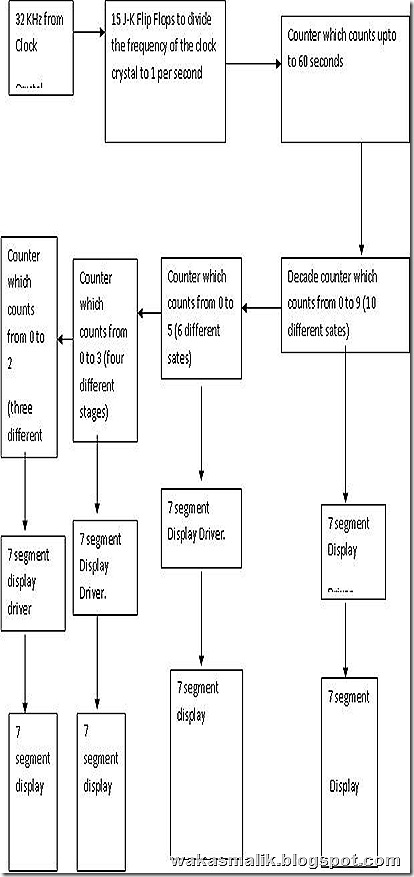
I need 15 flip flops to divide the clock crystal frequency to make it a 1 and then it will go to the input of the first decade counter which will count up to 9 and it will reset itself after 9 and when it is resetting itself that input will go to next counter of the minutes part which will count up to 6 and that will be the input for the next counter which is the first one in the hour part this counter will count up to 3 and resets itself at 4 which will become the input for the next and last counter which count up to 2 as this circuit is for the 24 hour clock.
An arithmetic logic unit is a combinational logic circuit used to perform arithmetic and logic operations. The ALU has a number of selection lines to determine the operations to be performed. These selection lines are decoded within the ALU circuitry so that ‘N’ selection lines can select up to 2(power N) operations. Most common operations of ALU are addition, subtraction and comparison of bits.
Finally, I have completed its design architecture.

Detailed Block Diagram of the ALU.
For the second year in a row, Mason was ranked as one of the top 100 North and Latin American universities by the Academic Ranking of World Universities. The analysis is conducted annually by Shanghai Jiao Tong University’s Institute of Higher Education.
Results can be found on the institute’s web site.
Universities are ranked by several indicators of academic or research performance. These include the number of alumni and staff members who have won Nobel Prizes or Fields Medals; the prevalence of highly cited researchers; the number of faculty articles published in the journals Nature and Science; and the frequency with which articles are indexed in major citations indices. The per capita academic performance of an institution is also considered.
“Mason is honored to be recognized for a second year in a row by Shanghai Jiao Tong University’s Academic Ranking of World Universities,” says Mason Provost Peter Stearns.
“This is an illustration of how committed Mason is to strengthening its relationships and boosting its global reputation with universities in the United States and abroad.”
As an institution that has made global education a priority, Mason offers a wide range of academic programs, from undergraduate degrees in global affairs and global and environmental change to doctoral programs in climate dynamics and other fields that foster global understanding. Several programs also require global residencies in which students learn how to live and work in a global society.
The university has also established research and educational collaborations abroad that provide opportunities for students and faculty members to work outside of the United States, participate in international research initiatives and address social issues around the world.
For example, the Sino-America 1+2+1 dual degree program, which Mason joined in 2004, is an international education initiative that brings American and Chinese universities together to offer dual degrees to Chinese undergraduate students.
In the program, students spend their freshman year at a Chinese university, their sophomore and junior years at an American university and their senior year back at their original university in China. After completing the program, students receive baccalaureate degrees from both schools.
The first 15 graduates of Mason’s 1+2+1 program received undergraduate degrees at a graduation ceremony in China in summer 2008, followed by 25 more students in summer 2009. Currently, there are approximately 90 students in the program in their second and third years of study.
Mason also provides its students opportunities to study almost anywhere in the world through its Center for Global Education. The center offers short-term, semester and yearlong honors study abroad; international internships; and intensive language programs in Asia, Africa, Europe, the Middle East, South America and the South Pacific.
Through Mason’s numerous centers and institutes, faculty members and students are working on some of the most pressing issues around the globe, including conflict analysis and resolution, Earth observing and space research, health policy research and international education.
Article Link : http://news.gmu.edu/articles/1173
Academic Ranking of World Universities – 2009 List : http://www.arwu.org/Americas2009.jsp
