Popular Posts

Sunday, January 24, 2010

Arithmetic Logic Unit (ALU)

An arithmetic logic unit is a combinational logic circuit used to perform arithmetic and logic operations. The ALU has a number of selection lines to determine the operations to be performed. These selection lines are decoded within the ALU circuitry so that ‘N’ selection lines can select up to 2(power N) operations. Most common operations of ALU are addition, subtraction and comparison of bits.

Finally, I have completed its design architecture.

 ALU

Detailed Block Diagram of the ALU.

Monday, January 4, 2010

Mason Recognized in Top 100 of Academic Ranking of World Universities

By Catherine Ferraro

For the second year in a row, Mason was ranked as one of the top 100 North and Latin American universities by the Academic Ranking of World Universities. The analysis is conducted annually by Shanghai Jiao Tong University’s Institute of Higher Education.

Results can be found on the institute’s web site.

Universities are ranked by several indicators of academic or research performance. These include the number of alumni and staff members who have won Nobel Prizes or Fields Medals; the prevalence of highly cited researchers; the number of faculty articles published in the journals Nature and Science; and the frequency with which articles are indexed in major citations indices. The per capita academic performance of an institution is also considered.

“Mason is honored to be recognized for a second year in a row by Shanghai Jiao Tong University’s Academic Ranking of World Universities,” says Mason Provost Peter Stearns.

“This is an illustration of how committed Mason is to strengthening its relationships and boosting its global reputation with universities in the United States and abroad.”

As an institution that has made global education a priority, Mason offers a wide range of academic programs, from undergraduate degrees in global affairs and global and environmental change to doctoral programs in climate dynamics and other fields that foster global understanding. Several programs also require global residencies in which students learn how to live and work in a global society.

The university has also established research and educational collaborations abroad that provide opportunities for students and faculty members to work outside of the United States, participate in international research initiatives and address social issues around the world.

For example, the Sino-America 1+2+1 dual degree program, which Mason joined in 2004, is an international education initiative that brings American and Chinese universities together to offer dual degrees to Chinese undergraduate students.

In the program, students spend their freshman year at a Chinese university, their sophomore and junior years at an American university and their senior year back at their original university in China. After completing the program, students receive baccalaureate degrees from both schools.

The first 15 graduates of Mason’s 1+2+1 program received undergraduate degrees at a graduation ceremony in China in summer 2008, followed by 25 more students in summer 2009. Currently, there are approximately 90 students in the program in their second and third years of study.

Mason also provides its students opportunities to study almost anywhere in the world through its Center for Global Education. The center offers short-term, semester and yearlong honors study abroad; international internships; and intensive language programs in Asia, Africa, Europe, the Middle East, South America and the South Pacific.

Through Mason’s numerous centers and institutes, faculty members and students are working on some of the most pressing issues around the globe, including conflict analysis and resolution, Earth observing and space research, health policy research and international education.

Article Link : http://news.gmu.edu/articles/1173

Academic Ranking of World Universities – 2009 List : http://www.arwu.org/Americas2009.jsp

Wednesday, November 11, 2009

Hyper-Threading (HT) Technology

Faster clock speeds are an important way to deliver more computing power. But clock speed is only half the story. The other route to higher performance is to accomplish more work on each clock cycle, and that's where Hyper-Threading Technology comes in. A single processor supporting Hyper-Threading Technology presents itself to modern operating systems and applications as two virtual processors. The processor can work on two sets of tasks simultaneously, use resources that otherwise would sit idle, and get more work done in the same amount of time.

Greater resource utilization equals greater performance and responsiveness.

HT Technology takes advantage of the multithreading capability that's built in to Windows XP and many advanced applications. Multithreaded software divides its workloads into processes and threads that can be independently scheduled and dispatched. In a multiprocessor system, those threads execute on different processors. HT Technology allows a single Pentium 4 processor to function as two virtual or logical processors. There's still just one physical Pentium 4 processor in your PC — but the processor can execute two threads simultaneously.

Tuesday, October 13, 2009

Professional Approach to Data Mining

I worked as a Data Stream Analyst with one of the nation’s top five market research firm. My duties involved data mining tasks which though; I had been doing but was unaware of its actual aspects. Then I took a introduction to data mining course during my pursue of Masters of Software Engineering degree at George Mason University which helps me to gain knowledge and maturity in this field. This course helps me to classify my daily tasks at job very easily. I will now try to relate some of my professional experiences with data mining tasks in this article which might be a good overview for beginners in this field. The data mining steps are:

Steps involve in Data Mining

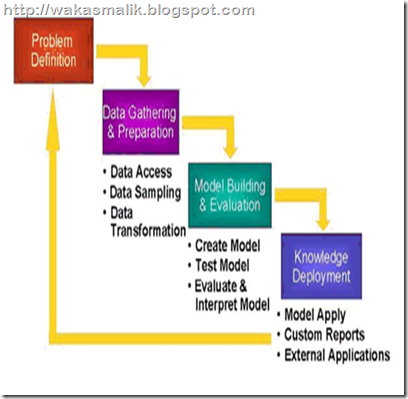
Originally Data Mining consists of seven steps, as you can see above, but we combine  a couple of steps and comes with this diagram below:

Professional Steps involve for Knowledge Discover

So lets begin with Problem Definition first.

Step 1 Problem Definition:

In this step the problem definition is established. By problem definition it infers to the actual task for which the data mining is needed. As an example one of our clients wants to know his business progress geographically. Like

Visa Credit Card is being used mostly where?

There are four type of credit card being used widely American Express, MasterCard, Discover and Visa. Visa is one of our client and they want know in which part of the country there cards are mostly used and in which parts they cards neglected widely and what are the reasons behind it. 

Step 2 Data Gathering & Preparation:

We have two kinds of data streams, ecommerce; which involves data coming from online shopping sites like buy.com, amazon.com, eBay.com etc. and financial data stream which involves the data coming from online banking sites like bankofamerica.com, chevychase.com etc. Now in order to scrap the data which is required for analysis we code software agents and these agents will gather data for us. These agents not only help us in data gathering but they also do data cleaning for us and for this purpose we make patterns in software agents which will clean the data. Once the data is being gathered and cleaned we are ready for the data sampling. We will sample data in four types according to the requirement of our clients for example how we are reporting our client means monthly, quarterly, semi and or on yearly basis.

Step 3 Model Building & Evaluation:

We will build and test the model on the past data that we have it and then run it on the new data that we just gathered for the recent quarter.  The models are separately built for each client and for each client’s requirement. For example Visa credit cards geographical customer report modeler is different than it’s quarterly expense report modeler. So for each site and for each specific purpose we create different model from its past behavior data trends.

Step 4 Knowledge Deployment:


As it is described before that our Knowledge Deployment depends on creating custom reports depending on the customer requirement. This can vary from anything to know its own profit report or to get an idea of the competitors business in that region for launching a new product. Our custom reports provide all the information which can be helpful in increased revenue. Our reports are supported by the facts of the past data which is helpful is making a strong impact on the clients.

Example Reports:

  • E-Commerce Spending on Black Friday Jumps 42 Percent Versus Last Year.
  • Consumer Online Retail Spending Tops $610 Million Per Day for Five Consecutive Days as Online Holiday Season Spending Grows 25 Percent vs. 2005.
  • Fox Interactive Media Ranks #1 in Page Views; Yahoo! Sites Attract the Most Unique Visitors.
  • 23 million People Watched More Than 2 Billion videos online in France in January 2008


I hope this will help some of us to understand how data mining is been done at a professional level. This will also clear student’s perspective of data mining being used now a days as some of my class fellows were not able to get it while we were taking Introduction to Data Mining course.